
Should you lend money to your CFC?
Hello and welcome once again to The Friday Edition. Phil Hodgen here again with more international tax stuff. Today I highlight how international practice differ from domestic practice and why reflexes honed on plain vanilla Subchapter C might lead you astray. Every single word came straight from my brain to the keyboard. No AI. (Weird flex there, right?)
But first . . .
Milan Workshop – Late September 2027
- I’m going to have a small workshop/meetup in Milan sometime in September 24-26, 2027. Details are getting nailed down now (thanks Monika). It will be limited to about 15 people.
- There will be an hour of CPE/CE credit, but that’s just an excuse. The real value will be the food/socializing afterwards.
- Announcement email coming soon.
Early Bird Lists
Put your name on the announcement lists for these events to get first crack at the early bird tickets.
- Milan International Tax Summit – late February 2027.
- London International Tax Summit – June 25, 2027. The contract for the venue (same place as last year) has been signed.
Capital Contribution or Loan?
Assume a CFC with one U.S. shareholder, who wants to put $100,000 into the CFC. What is the best way to capitalize a CFC? Capital contribution or loan?
Answer: capital contribution.
- If a shareholder makes a capital contribution to a CFC, there is one possible source of income on the shareholder’s Form 1040 from the CFC: net profit classified as Subpart F income or Net CFC Tested Income (IRC §951A).
- If a shareholder lends money to a CFC, there are two possible sources of income on the shareholder’s Form 1040 from the CFC: (1) net profit classified as Subpart F income or Net CFC Tested Income (IRC §951A); and (2) interest income received from the CFC’s loan payments.
I am going to show you how loans to a CFC can only make things worse, never better.
The Baseline: Capital Contribution
Let’s start with the simple case: the U.S. shareholder makes a $100,000 capital contribution to the CFC. The CFC puts the money in the bank, earning 5% interest. At the end of the year, the CFC has $5,000 of interest income.
Interest income is foreign personal holding company income. IRC §954(c)(1)(A). Foreign personal holding company income is foreign base company income. IRC §954(a)(1). Foreign base company income is subpart F income. IRC §952(a)(2). The U.S. shareholder includes his pro rata share (100% in this example) of the CFC’s subpart F income in his gross income on Form 1040. IRC §951(a)(1)(A).
Therefore, the U.S. shareholder has $5,000 of subpart F income from the CFC in the taxable year.
Loan: Scenario 1 (CFC income greater than CFC interest expense)
Now the first of two loan scenarios.
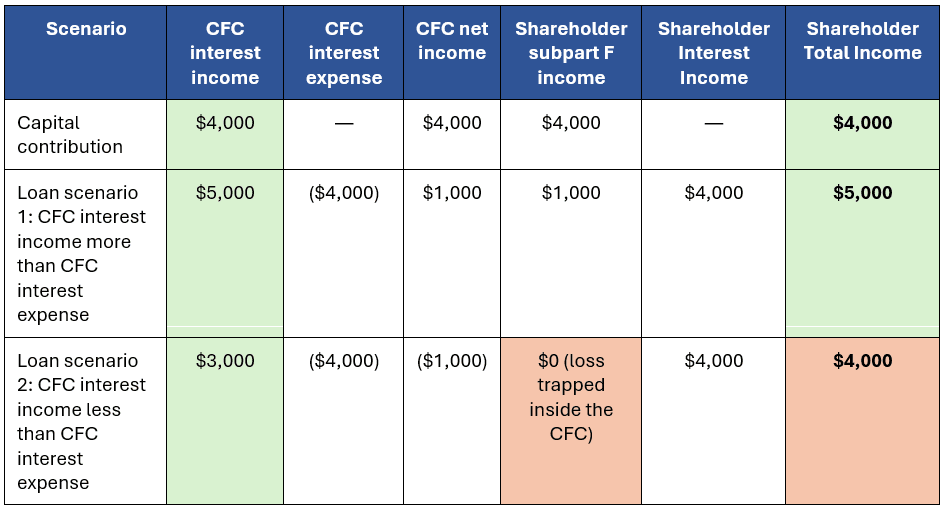
The U.S. shareholder lends $100,000 to the CFC at a 4% interest rate. The CFC puts the money in the bank and earns 5% interest. At the end of the year, the CFC’s P & L looks like this:
- Interest income: $5,000
- Less interest expense: ($4,000)
- Net profit: $1,000
For the reasons given above, the CFC’s net profit is subpart F income, included in the U.S. shareholder’s gross income on Form 1040. The U.S. shareholder also has $4,000 of interest income received from the CFC.
At the end of the taxable year, the shareholder’s Form 1040 looks like this:
- Subpart F income: $1,000
- Interest income: $4,000
- Total income: $5,000
The shareholder has the same amount of income, but has transformed the character of $4,000 of income from subpart F income to interest income. Which is interesting and may or may not have economic value to the shareholder, but that’s not what we are talking about right now. We’re just talking about total income.
The point: as long as the CFC is profitable, the U.S. shareholder’s total income picture will be the same with loans to a CFC as it will be with capital contributions to the CFC.
Loan Scenario 2: (CFC Income Less Than CFC Interest Expense)
The problem reveals itself if the CFC runs a loss on its P & L. In that situation, the loss gets trapped, unused, in the CFC while the shareholder pays income tax on the interest paid by the CFC to create that loss.
Again, assume the shareholder lends $100,000 to the CFC at a 4% interest rate. The CFC puts the money in the bank and earns 3%. At the end of the year, the CFC pays the interest to the shareholder. The CFC’s P & L says:
- Interest income: $3,000
- Less interest expense: ($4,000)
- Net profit: ($1,000)
There is no subpart F income to pass through to the shareholder. Only income passes through, not loss. The shareholder’s Form 1040, then, shows a single entry: interest income of $4,000.
Note what happens: real world income was only $3,000 but the shareholder’s taxable income is $4,000. There is a loss trapped inside the CFC that maybe if you’re lucky you can use to offset future CFC income. (I’m not going to talk about the mechanics of how it get trapped, how you report it on Form 5471, and how the CFC uses it in the future—that’s outside the scope of what I’m illustrating here).
But even if the CFC does happen to generate future years foreign personal holding company income that is offset by the $1,000 trapped loss, it’s still suboptimal. PV/FV and all that stuff, right? Why pay tax today just so you don’t pay tax next year?
Summary Table
Collateral Damage
What if the CFC runs at a loss and there is not enough income to pay interest to the shareholder? Can’t they agree to defer the interest to a later year? Yes, but now you have to figure out if there is a “sale or exchange” of a debt obligation for another debt obligation under IRC §1001. And you have to figure out if there are OID problems under IRC §§1271-1274. Wouldn’t you rather NOT figure that stuff out? Take it from me. That stuff is dreadful.
“I have a reasons to make a loan instead of a capital contribution.” OK then. Go for it. My approach to life is to start with the absolute simplest idea and then make every added complexity visible so it justifies the price tag. Have a reason. Document it: “By lending the CFC money instead of a capital contribution, we (insert compelling business reason here) which has an estimated value of (insert economic value of doing your clever idea) which exceeds (insert estimated cost of additional accounting, tax compliance, executive distraction, and structural rigidity), and this is how the whole picture unwinds when we want it to unwind.”
Distributions
One of the main reasons that people love loans rather than capital contributions is that principal repayments come back to the lender tax-free. With a CFC, distributions to the shareholder will be from previously-taxed earnings and profits (IRC §959) so will be income tax-free to the shareholder. (Granted: pesky net investment income tax will apply at 3.8%).
Conclusion
Well, there you are. Keep it simple when offering business structuring advice. I personally avoid setting up loans with CFCs if I can. It is too easy to have income in one place and the offsetting loss or interest expense deduction languishes out of reach. Plus, let’s be real. There is a lot of entropy in the general ledger and more often than not we face a difficult problem of rebuilding past financial history from incomplete records. The easiest interest accrual and debt repayment records to clean up are the ones that never existed because there was no debt.
(Grumpy rant over).
Did you know members get on a live call every month to work through their hardest problems?
International tax practitioners, one live AMA session a month, and the questions you can’t find answers to anywhere else. One answer can save you five hours of research.