Contract-based U.K. personal pension schemes
Hello, it’s Phil Hodgen. Welcome to the Friday Edition, your every-other-week international tax missive.
New and Upcoming
- International Tax Lunch with Debra Rudd talking about IRC §2801 – when covered expatriates make gifts or leave bequests to U.S. persons. July 31, 2026, 9:00 a.m. PDT.
Distant Horizons
- Meetup in Milan, late September, 2027. I’m in Milan in late September. If you want to meet up, let’s do it. Email me. (I go to Milan with my wife during Fashion Week).
- Milan International Tax Summit, February 26, 2027. We’ve had two years of success in London. Let’s do an all-day tax conference in Milan, too. If you’re interested and want to be on the early-bird ticket list, sign up here.
- London International Tax Summit, June 25, 2027, with a Business of Practice workshop on June 26, 2027. The Great Room at Chartered Accountants Hall has already been reserved for our third annual summit. To get on the early-bird ticket list, sign up here.
Let’s get back to SIPPs, shall we?
A reader (thanks Melanie M.) was kind enough to comment that a lot of U.K. personal pension schemes are not, in fact, trust-based. Meaning? The pension assets are not held in a trust. This has implications for how the Internal Revenue Code classifies and taxes U.S. members of these schemes, as well as the reporting requirements.
An example
Here’s the excerpt of what Melanie sent me from a sample document:

You can find the same text in the Quilter document (Old Mutual Wealth –> Quilter: same-same company) on page 2.

Not a Trust
When you establish your personal pension scheme with Quilter under this specific arrangement, you are not contributing money to a trust, where a trustee owns the asset and you are the beneficiary. Instead, you are buying an insurance product. You have a contract with an insurance company. You give them money now. They promise to give you more money later.
That’s not a “trust” as that word is defined in Reg. §301.7701-4(a) (emphasis added):
(a) Ordinary trusts. In general, the term “trust” as used in the Internal Revenue Code refers to an arrangement created either by a will or by an inter vivos declaration whereby trustees take title to property for the purpose of protecting or conserving it for the beneficiaries under the ordinary rules applied in chancery or probate courts. Usually the beneficiaries of such a trust do no more than accept the benefits thereof and are not the voluntary planners or creators of the trust arrangement. However, the beneficiaries of such a trust may be the persons who create it and it will be recognized as a trust under the Internal Revenue Code if it was created for the purpose of protecting or conserving the trust property for beneficiaries who stand in the same relation to the trust as they would if the trust had been created by others for them. Generally speaking, an arrangement will be treated as a trust under the Internal Revenue Code if it can be shown that the purpose of the arrangement is to vest in trustees responsibility for the protection and conservation of property for beneficiaries who cannot share in the discharge of this responsibility and, therefore, are not associates in a joint enterprise for the conduct of business for profit.
Among other things, in a trust arrangement “trustees take title” to assets. In the Old Mutual Wealth/Quilter example above, that doesn’t happen. You are the holder of the asset: a contract claim against Quilter.
Diagram
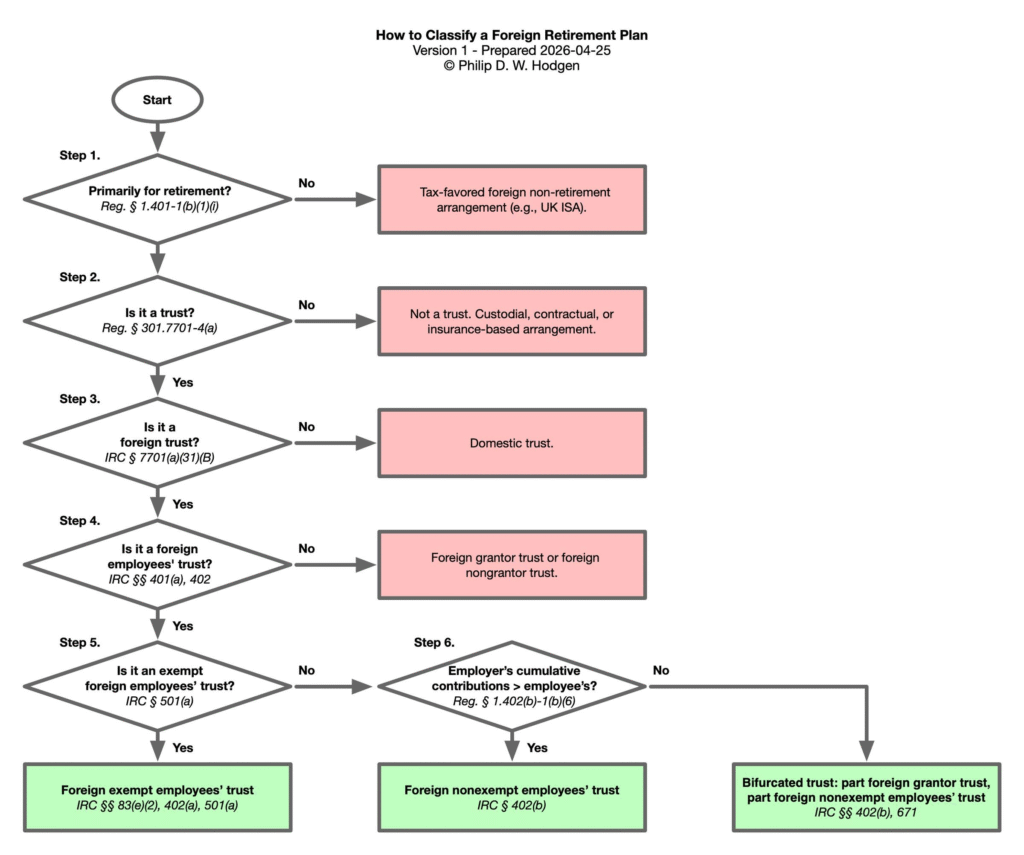
Revisiting my generic diagram for classifying foreign retirement plans from April, it’s easy to see where the contract-based personal pension scheme takes the offramp. Step 2 asks “is this a trust?” and the analysis is done using Reg. §301.7701-4(a).
If the answer is “no” you now have the extremely interesting question of “what is this personal pension scheme in the eyes of the Internal Revenue Code?” and the answer will be either an insurance product or a taxable financial account.
uk-sipp-classification-flowchart.pdf
Implications
If the pension scheme is not a trust, then the reporting requirements for U.S. persons who create or make transfers to a foreign trust will not apply. IRC §6048(a). No Form 3520.
If the pension scheme is not a trust, it cannot be a foreign grantor trust. IRC §6048(b). No Form 3520-A.
If the pension scheme is not a trust, then you do not have to wrestle with the member’s income tax treatment of contributions, distributions, and investment earnings as determined under IRC §402(b).
And if it’s a foreign grantor trust, with the member owning the pension scheme qua trust and therefore being directly taxable on its investment earnings.
But on the other hand, you have a new set of questions. The fine print says this is a “unit-linked life assurance contract.”
- Life assurance contract raises the question of whether this is a life insurance contract or annuity, as defined in IRC §7702. The U.S. income tax treatment of the investment earnings can turn on that question: tax-free buildup of value generally occurs inside a life insurance policy. If the life assurance contract is not a life insurance contract as defined in IRC §7702, then investment income is taxable when earned, every year.
- Also, PFICs inside a life insurance policy are not the policy holder’s problem: the U.S. taxpayer owns an insurance policy, not shares of a PFIC. If the life assurance contract does not satisfy IRC §7702, Form 8621 becomes a feature of your income tax return.
Conclusion
The moral of this story is that not all U.K. personal pension schemes are trusts. Get the pension documents and figure out what you have, and what the Internal Revenue Code thinks you have. Only then can you figure out what the reporting requirements are and how the U.S. member of the U.K. personal pension scheme will be taxed on Form 1040.
Thanks again Melanie M. for the little .png file and the email, and also to Keith M. who brought up a similar comment several months ago.
Did you know you don’t have to figure out questions like this one alone?
The kind of issue this Friday Edition unpacks is exactly what members of the International Tax Pros community post in the forum — and get answered, often within the hour, by practitioners who’ve already done the work.
No more researching alone at 8 p.m. on a Friday.